
Startups & Business
The 2026 Series A Bar Just Got Higher: Why Seed-to-Series-A Conversion Rates Are Falling
Sep 18, 202613 min read
By WorldFinance Editorial Team
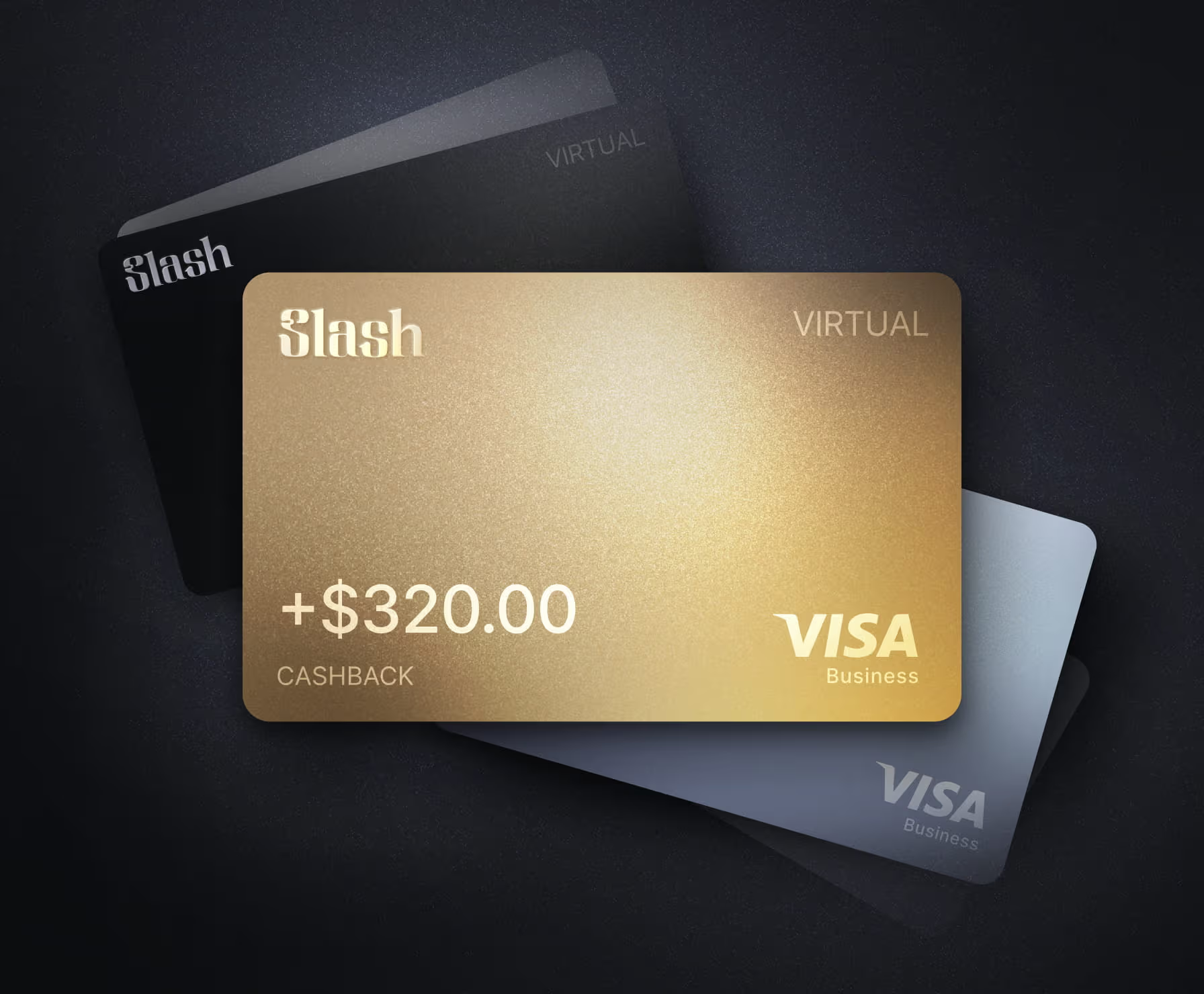
Slash raised $100 million at a $1.4 billion valuation to challenge Ramp and Brex, but the landscape shifted fast: Brex was acquired by Capital One and Ramp raised $750M at a $44B valuation.
Slash, a business banking startup founded by Victor Cardenas and Kevin Bai when they were just 19 years old, closed a $100 million Series C round in 2026, pushing its valuation to $1.4 billion. The company — now five years old, with its founders at 24 — has scaled to roughly $300 million in annualized revenue serving thousands of businesses (TechCrunch). Slash differentiates itself from incumbents by building its own underlying banking infrastructure and layering AI-powered tools on top, rather than relying purely on a corporate-card product (Crowdfund Insider).
Here's what makes Slash's timing notable: the market it's entering looks nothing like it did even a year ago. Capital One announced a $5.15 billion agreement to acquire Brex in January 2026, and that deal closed on April 7, 2026 — meaning Brex, one of the two incumbents Slash is explicitly positioned against, is no longer an independent fintech company but a division of one of the largest US banks (GetKleerCard). Meanwhile, Ramp has only gotten bigger: the company raised $750 million in June 2026, led by ICONIQ Growth, GIC, and the Ontario Teachers' Pension Plan, at a $44 billion valuation — roughly 31 times Slash's current valuation.
Slash's positioning as a challenger to "Ramp and Brex" now means two very different things depending on which company you mean. Competing with Ramp means competing against a company that just raised three-quarters of a billion dollars at a valuation over 30 times Slash's own — a scale gap that's widened, not narrowed, since Slash's own round. Competing with Brex now effectively means competing against Capital One's fintech arm, a company with the balance sheet, banking license infrastructure, and regulatory relationships of a major national bank behind it, a fundamentally different competitive dynamic than fighting an independent startup.
Despite that scale disadvantage, Slash's $300 million in annualized revenue and $1.4 billion valuation suggest investors see room for more than two winners in business banking. The sector's growth has been driven by a genuine shift away from legacy commercial banking toward software-native financial products — real-time spend controls, automated expense categorization, and AI-driven financial insights that traditional banks have historically been slow to build. A newer, smaller player with modern infrastructure and a fast product cycle can still carve out a defensible niche, particularly among the kind of younger, high-growth companies that identify more with founder-led fintech brands than with either a bank-owned incumbent or an established unicorn.
For companies evaluating corporate card and spend management providers, the practical calculus has shifted. Brex now carries the backing (and potential bureaucracy) of a major bank behind its products. Ramp has enormous scale and capital to keep investing in its platform. Slash offers a smaller, more specialized alternative built on its own banking infrastructure — a meaningful differentiator if a business specifically wants a fintech-native banking relationship rather than card-processing layered on top of a partner bank. As with any vendor decision in a consolidating market, it's worth weighing not just current features but which of these companies is likely to still exist in its current form in a few years.
How much did Slash raise, and at what valuation? $100 million in a Series C round, valuing the company at $1.4 billion.
Who founded Slash? Victor Cardenas and Kevin Bai, who started the company when they were 19 years old; the company is now about five years old and they're 24.
Is Brex still an independent company? No — Capital One acquired Brex in a $5.15 billion deal announced in January 2026, which closed on April 7, 2026. Brex now operates as part of Capital One.
How does Slash's valuation compare to Ramp's? Ramp is valued at roughly $44 billion after raising $750 million in June 2026 — more than 30 times Slash's $1.4 billion valuation.
What makes Slash different from Ramp and Brex? Slash has built its own underlying banking infrastructure rather than relying entirely on a bank partner, and layers AI-powered financial tools on top, differentiating itself on infrastructure ownership and product depth rather than just card features.
How much revenue does Slash generate? Roughly $300 million in annualized revenue as of its 2026 Series C round.