Asian Markets
Japan’s 2026 Digital Yen Pilot: What It Means for Payments, Crypto and Asia’s Financial Future
Sep 8, 202612 min read
By WorldFinance Editorial Team
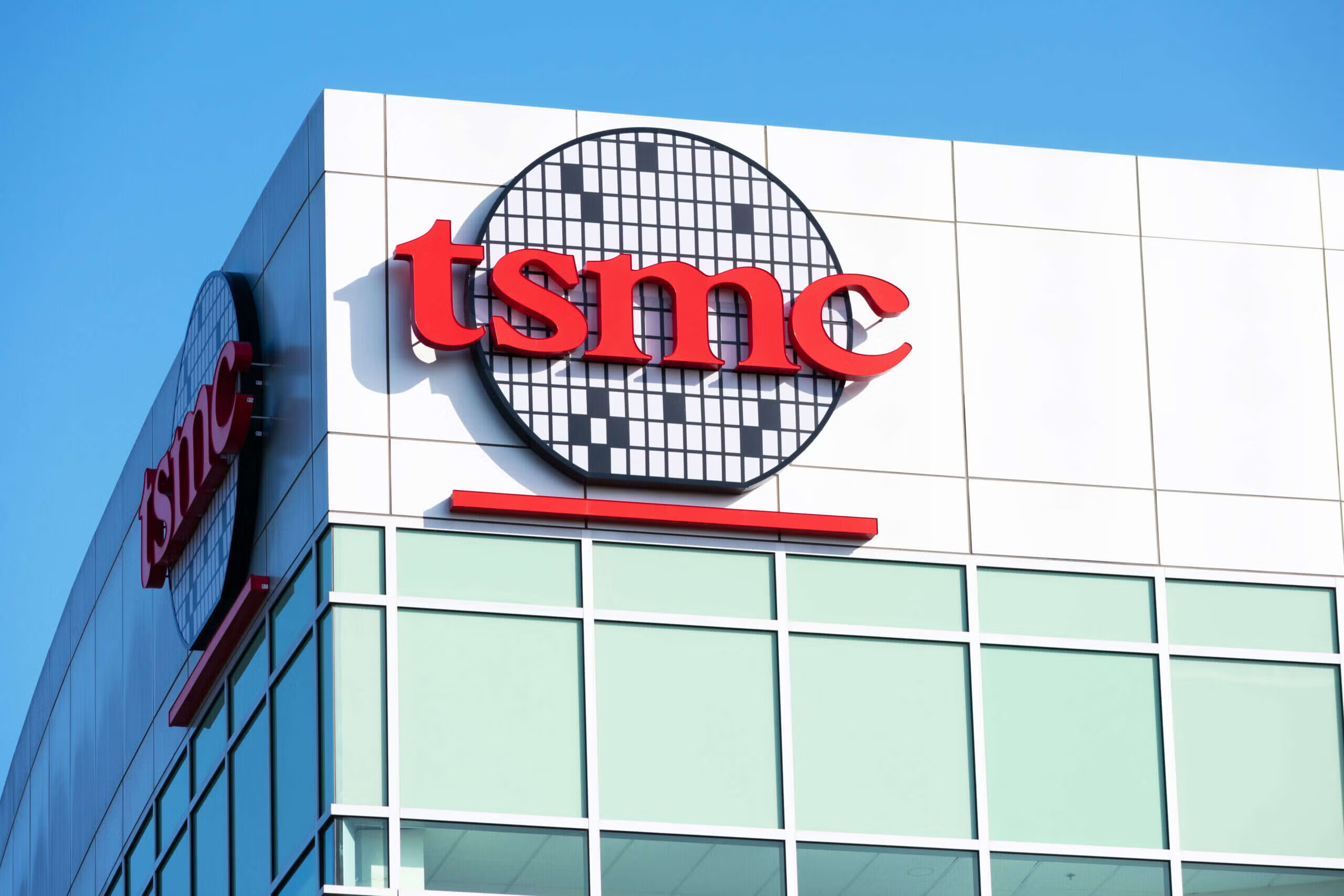
TSMC just committed another $100 billion to Arizona while its Taiwan-based capacity keeps setting records. For Asian markets, that combination is both the best news of the year and the thing keeping fund managers up at night.
There's a strange tension sitting at the center of Asian markets right now, and it has a name: TSMC. The company just posted a record first-quarter 2026 revenue of $35.6 billion, comfortably beating analyst consensus, while simultaneously pouring another $100 billion into Arizona fabs that will, by design, move a meaningful slice of its most advanced manufacturing capacity out of Taiwan. Investors are cheering the earnings and quietly worrying about the geography. Both reactions are correct, and understanding why is the key to reading Asian equity markets for the rest of this year.
TSMC isn't just expanding in the U.S. — it's building an entire manufacturing cluster. The company has committed to as many as 12 fabs in Arizona, and it isn't slowing down: it purchased an additional 364-hectare plot there in January 2026 to make room for more. The first Arizona fab (Fab 21 Phase 1) already entered volume production back in late 2024. The second fab's construction is largely done, tool installation is underway in 2026, and — notably — TSMC pulled forward its production timeline to the second half of 2027 because demand from U.S. customers was too urgent to wait for the original schedule (DigiTimes). A third fab is under construction, and applications are already in for a fourth fab plus the company's first advanced packaging facility on the same site.
The dollar figures behind this are enormous. TSMC's total Arizona commitment now sits at roughly $165 billion, and 2026 capital expenditure could reach $64 billion company-wide once this latest Arizona round is folded in (Tom's Hardware) — well above the $44-46 billion market estimates that were circulating for 2026 before the announcement. Once the Arizona cluster is fully built out, roughly 30% of TSMC's 2nm and more advanced capacity will physically sit in the U.S. rather than Taiwan.
Compare that to what's happening elsewhere. Japan and Germany, TSMC's other two overseas expansion bets, are effectively stalling relative to Arizona. The Kumamoto fab in Japan is running with strong yields, but a planned second specialty fab in Dresden, Germany is contingent on local infrastructure catching up — which is a polite way of saying it's not moving quickly. Arizona is where the capital, the urgency, and the customer demand are all pointing at once, and that's exactly what's unsettling for the Asian side of the ledger.
Here's the thing that's easy to miss if you're only watching TSMC's stock price: Taiwan's market has become extraordinarily dependent on this one company and the AI-chip trade it represents. Taiwan's benchmark Taiex index has been posting new records repeatedly, driven almost entirely by investors piling into semiconductor names at the center of the AI boom. Taiwan is now estimated to be "well over 80%" exposed to AI-related revenue streams, with South Korea — home to Samsung and SK Hynix — sitting around 60% by the same measure (CNBC).
That's a concentration risk hiding inside a boom. When a single sector — arguably a single supply chain, anchored by a single company — accounts for that much of a national index's movement, the index stops behaving like a diversified basket of the economy and starts behaving like a leveraged bet on one theme. Fund managers running Asia-Pacific mandates have been openly discussing this: it's great until AI capex growth decelerates even slightly, at which point the same concentration that powered the rally amplifies the drawdown.
It helps to see why investors keep piling in anyway. TSMC's market capitalization sits at approximately $2.2 trillion. The stock is up 58% over the past 52 weeks and roughly 36% year-to-date. AI and high-performance computing now make up 57% of TSMC's total revenue, and AI chip sales specifically are projected to grow at a 60% compound annual rate through 2029 (Yahoo Finance). TSMC also controls roughly 90% of global advanced-node chip manufacturing — which is another way of saying that nearly every cutting-edge Nvidia GPU, most AMD processors, and every recent Apple silicon chip physically passes through a TSMC fab before it reaches a customer.
When one company sits at that kind of chokepoint in a supply chain everyone wants exposure to, capital treats its expansion announcements almost like central bank decisions. The Arizona buildout isn't just a manufacturing story — it's a signal about where TSMC expects durable demand to come from, and markets are pricing that signal in real time.
The reason Arizona matters so much isn't only about diversifying manufacturing footprint for its own sake. It's about what happens if Taiwan becomes inaccessible, even temporarily. Over 90% of TSMC's advanced-node capacity currently sits in Taiwan. Any serious military escalation or blockade in the Taiwan Strait wouldn't just hurt TSMC's stock — it would freeze the global AI supply chain overnight, given how few alternatives exist at the leading edge.
That risk isn't purely hypothetical background noise. Taiwan imports roughly 97% of its energy, and disruptions in shipping routes — the kind that have already been debated in the context of a Strait of Hormuz blockade scenario — would threaten the energy and raw-material inputs that keep Taiwan's fabs running long before any direct conflict touched the island itself. Investors underwriting Taiwan-heavy portfolios are, whether they say it explicitly or not, underwriting a geopolitical risk premium that doesn't show up cleanly in a P/E ratio.
This is the actual logic behind Arizona. It's not that TSMC thinks Taiwan production is going away — it's the world's most advanced semiconductor manufacturing base, full stop, and that's not changing this decade. It's that having 30% of leading-edge capacity somewhere geopolitically insulated changes the risk calculus for TSMC's biggest customers, who have been quietly asking for exactly this kind of redundancy for years.
Geographic diversification in semiconductors isn't a new idea — it's just historically been slow and expensive enough that most companies talked about it far more than they acted on it. Chipmakers have spent decades concentrating advanced manufacturing in East Asia because that's where the ecosystem of suppliers, skilled labor, and infrastructure already existed. Building a fab from scratch somewhere else doesn't just mean pouring concrete; it means recreating an entire supporting cast of specialty gas suppliers, ultra-pure water systems, and technicians trained on equipment that took years to master.
What makes TSMC's current push different is scale and urgency. Previous overseas expansion attempts across the industry tended to be smaller, slower-walked projects aimed at appeasing a specific government or landing a specific subsidy. Arizona is neither of those things — it's a full-scale attempt to replicate a meaningful fraction of leading-edge capacity outside Taiwan, backed by a company that has never needed outside help to fund its own expansion. That's a signal in itself: TSMC isn't building in Arizona because it has to chase subsidies. It's building there because its biggest customers have made clear that geographic concentration risk is now a real commercial concern, not just a talking point in earnings calls.
The pace also tells its own story. Pulling the second Arizona fab's production timeline forward, rather than pushing it back, is the opposite of what you'd expect from a company hedging its bets cautiously. It reads more like a company racing to meet demand it's confident is coming, which lines up with the 60% CAGR growth projected for AI chip revenue through the rest of the decade.
The ripple effects extend well past TSMC's own balance sheet. A supply chain this concentrated doesn't move in isolation — every supplier, testing house, and packaging partner tied to TSMC's Taiwan operations has to think about how much of their own business follows the capacity to Arizona, and how much stays anchored in Taiwan supporting the fabs that aren't going anywhere.
Some of this is already visible in equipment and materials suppliers repositioning around new U.S. facilities, while others are doubling down on expanding their Taiwan and Japan footprints to stay close to TSMC's core R&D and next-generation process nodes, which remain firmly based in Taiwan regardless of where volume manufacturing eventually happens. South Korea's chipmakers are watching closely too — Samsung and SK Hynix aren't standing still while TSMC reshapes where advanced capacity sits, and any shift in customer sentiment toward geographic diversification could just as easily pull demand toward Korean fabs as toward Arizona, depending on pricing and yield competitiveness.
For companies further down the supply chain — automakers, consumer electronics manufacturers, data center operators — the practical question is less about geopolitics and more about lead times and allocation. TSMC's accelerated Arizona timeline, pulling volume production forward to the second half of 2027, suggests the company is trying to get ahead of a demand wall it sees coming, not reacting to a slowdown. That's generally a bullish signal for anyone downstream who's been struggling to secure advanced-node allocation.
Looking at how professional investors are treating this, the split roughly comes down to time horizon. Shorter-term traders are still chasing the AI capex story directly through TSMC and its most exposed suppliers, betting that 60% CAGR growth in AI chip revenue through 2029 simply overwhelms any near-term concentration worries. Longer-horizon allocators, on the other hand, have been quietly trimming pure-Taiwan exposure in favor of a basket that includes South Korean chipmakers, U.S.-listed semiconductor equipment names benefiting from the Arizona buildout, and even some Japanese suppliers tied to TSMC's Kumamoto operations — a way to keep AI-chip exposure while diluting the single-country risk.
There's also a growing conversation among analysts about whether Taiwan's export controls — restrictions on where the most advanced chips and manufacturing know-how can go — will tighten further as the Arizona buildout matures, and what that means for TSMC's China-facing revenue and valuation multiple going forward. That's a live debate with no clean resolution yet, but it's exactly the kind of variable that can move Taiex sentiment on a single headline.
None of this positioning happens in a vacuum, either. Currency moves matter here too — a stronger Taiwan dollar against the U.S. dollar changes the math on TSMC's dollar-denominated Arizona spending relative to its Taiwan-based costs, adding yet another variable that shifts the calculus for how much of that $64 billion capex budget effectively goes further or less far depending on where exchange rates sit when the bills come due. As TSMC's weight in regional benchmarks keeps climbing, its volatility increasingly becomes the market's volatility — when one name gets heavy enough in an index, that's simply what happens, whether or not anyone intended it that way.
For anyone investing in this trend without a Bloomberg terminal and a dedicated semiconductor analyst on staff, a few concrete signals matter more than the headline stock moves. First, watch TSMC's own capex guidance each quarter — when a company that controls 90% of advanced-node manufacturing raises its spending forecast mid-year like it just did, that's a far more reliable demand signal than any single customer's earnings call. Second, pay attention to how Taiwan's export control policy evolves; any tightening around what technology and know-how can leave Taiwan directly affects how much of TSMC's roadmap can realistically be replicated in Arizona versus kept at home.
Third — and this is the one retail investors tend to skip — look at the equipment and materials suppliers feeding into both Taiwan and Arizona simultaneously. They're often a cleaner, less geopolitically loaded way to get exposure to the AI-chip buildout broadly without betting directly on either country's concentration risk. A supplier selling into both ecosystems benefits regardless of whether the next marginal dollar of capex lands in Hsinchu or Phoenix.
Finally, resist the urge to treat "Taiwan risk" as a binary switch that's either fully priced in or completely ignored. It moves. Every time there's a headline about regional tensions, chip export rules, or Taiwan Strait activity, that risk premium reprices in real time across TSMC, its suppliers, and the broader Taiex — often faster than the underlying situation actually changes. Understanding that the premium is dynamic, not fixed, is more useful for position-sizing than trying to predict the next geopolitical headline itself.
TSMC's 2026 expansion doesn't change the fundamental math that's driven Asian tech markets for the past two years: AI demand is real, TSMC is still irreplaceable at the leading edge, and that combination has produced genuinely extraordinary returns. What's changing is the geography of where that story gets told. Arizona is becoming a second stage for a play that used to run almost entirely out of Taiwan, and that shift is going to keep showing up in how capital allocates across Taiwan, South Korea, and U.S.-listed semiconductor names for the next several years.
For anyone holding Asian tech exposure, the takeaway isn't to panic about Taiwan concentration risk — it's to understand that it exists, price it consciously rather than ignore it, and watch how TSMC's Arizona timeline evolves as a leading indicator of how the company itself is thinking about that same risk.
Q: How much is TSMC actually spending in Arizona? A: TSMC's total commitment to its Arizona site now stands at roughly $165 billion, including the latest $100 billion round announced for at least four more 2nm fabs, plus an advanced packaging facility.
Q: Does the Arizona expansion mean TSMC is leaving Taiwan? A: No. Even after the full Arizona buildout, over 90% of TSMC's advanced-node manufacturing will still be based in Taiwan, and the company's core R&D for next-generation process nodes remains there. Arizona adds geographic redundancy — it doesn't replace Taiwan's role.
Q: Why are Taiwan and South Korea's stock markets so exposed to AI chip demand? A: Taiwan's benchmark index is now estimated to be well over 80% exposed to AI-related revenue streams, largely through TSMC and its supply chain, while South Korea sits around 60% through Samsung and SK Hynix. Both markets have effectively become concentrated bets on the AI-chip cycle.
Q: What's the biggest risk to TSMC's Taiwan-based production? A: Geopolitical risk in the Taiwan Strait is the most-cited concern, but energy security is a related factor — Taiwan imports roughly 97% of its energy, so any disruption to regional shipping lanes could threaten fab operations well before any direct conflict does.
Q: Should investors reduce exposure to Taiwan-heavy semiconductor portfolios? A: That depends on risk tolerance and time horizon. Some longer-term allocators are diversifying into South Korean and U.S.-listed semiconductor names to keep AI-chip exposure while reducing single-country concentration, but Taiwan remains central to the industry regardless of how the Arizona buildout progresses.
Q: When will TSMC's Arizona fabs reach full production? A: The second Arizona fab's volume production has been pulled forward to the second half of 2027, ahead of the original schedule, reflecting what TSMC has described as urgent demand from U.S. customers. A third fab is already under construction, with a fourth in the application stage.